Apparently, the world has fully embraced Artificial Intelligence (or, more precisely, Large Language Models such as Gemini, ChatGPT, Claude and Deepseek).
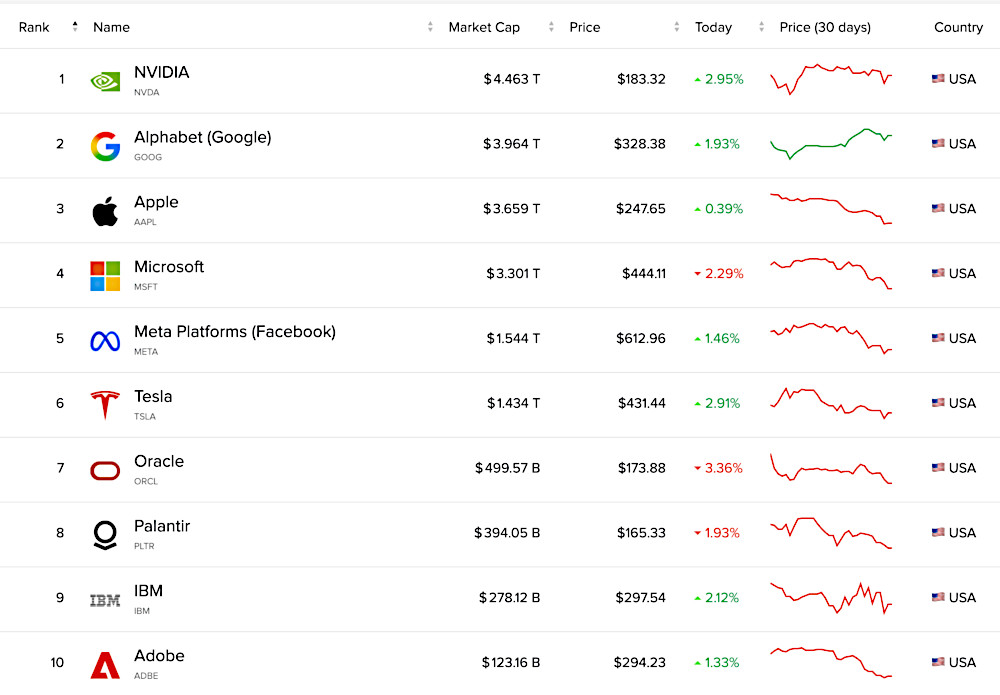
Looking at the market capitalisation of the largest technology companies in the world, it is amazing that all of them now say that they are AI companies first and foremost. Consequently, everyone investing in AI have poured money in these companies.

Personally, I believe that this kind of (mad) market capitalisation is thanks to the excellent communication strategy of those companies. They have made everyone believe that they are on the verge of bringing a revolution to the planet and that any sensible enough investor need to purchase their shares.
Interestingly, some of them (e.g. Apple and Meta) have no AI product to show at all. Some have been saying that they are good in AI (e.g. Microsoft, Palantir, etc.) but is it really AI that they are doing?
For example, I was watching this very sad video on YouTube the other day about young people from Madagascar earning peanuts to curate data for AI platforms. One person even mentioned that a company which sells AI security monitoring equipment actually employs young Malagasy to watch hours and hours of video to detect suspicious activity. This is clearly not AI.
In other words, many companies seem to be lying about AI. They are telling investors that they have something big (or are on the verge of having something big) while they don’t have much. It’s basically a scam. And the whole world is mad for falling in such scams.
A few days ago, Cory Doctorow wrote a wonderful opinion piece in The Guardian titled “AI companies will fail. We can salvage something from the wreckage.” In that article, he explains “how to pump a bubble”:
(1) When a company is growing, it is a “growth stock”, and investors really like growth stocks. When you buy a share in a growth stock, you are making a bet that it will continue to grow. So growth stocks trade at a huge multiple of their earnings.
(2) But here is the downside: eventually a company has to stop growing. Like, say you get a 90% market share in your sector, how are you going to grow? Once a company stops growing, it is a “mature” stock, and it trades at a much lower price-to-earnings ratio.
(3) Which is why growth-stock companies are always desperately pumping up one bubble or another, spending billions to hype the pivot to video or cryptocurrency or NFTs or the metaverse or AI.
Cory Doctorow continues:
“I am not saying that tech bosses are making bets they do not plan on winning. But winning the bet – creating a viable metaverse [for Facebook for example] – is the secondary goal. The primary goal is to keep the market convinced that your company will continue to grow, and to remain convinced until the next bubble comes along.
So this is why they’re hyping AI: the material basis for the hundreds of billions in AI investment.“
My opinion
I am a technologist and I really like how technology and innovation are formidable enablers. A country cannot progress without a good mastery and optimal usage of technology and innovation.
My mantra has always been: “It’s not about hardware or software though. It’s about peopleware.” But, as everyone knows, there is an enormous lack of competent people in the Mauritian society, at the level of our politicians, our civil servants, our CEOs of private companies, our teachers, our parents, our students, etc. The few who are competent are not enough for the country to have a critical mass of competencies.
Based on my past experience as a Senior Adviser for the Mauritian Government and a Head of an Innovation structure for the United Nations Development Programme in Mauritius, I predict that our dear Mauritian politicians and CEOs will definitely fall into the traps of all these AI and tech companies selling inexistent dreams and will waste years and enormous amount of resources chasing things that cannot be made.
If I were them, I would be very wary of salespeople and marketers from technology and AI companies.
This is an interesting video of Steve Jobs explaining the problem of companies forgetting how to make great product. For him, it’s when sales/marketing people get promoted (the talkers) instead of product people (the doers).
I suspect there are a lot of talkers at NVIDIA, Alphabet (Google), Apple, Microsoft, Meta Platforms (Facebook), Tesla, Oracle, Palantir, IBM and Adobe (and others like OpenAI, etc.) these days…